
In the quiet hills near the village of Livesay’s Mill, now known as Greenbrier County, the winter of 1897 settled heavily over a farming community where neighbors knew one another by name and reputation mattered as much as truth. It was here that a young woman named Zona Heaster Shue lived a brief and troubled life that would soon become one of the most unusual legal cases in American history. Zona had married a blacksmith, Erasmus Stribbling Trout Shue, not long before her death, a man who had drifted into the area with a shadowy past and an intensity that unsettled some who met him. Their marriage was sudden and, to some in the community, uneasy from the start.
On a cold morning in late January, a young boy sent on an errand arrived at the Shue home and discovered Zona’s body lying at the foot of the stairs. She was dressed neatly, more carefully than one might expect for a woman alone at home, and her body was positioned in a way that seemed staged. When word spread, the local physician, George W. Knapp, was summoned to examine her. But before he could conduct a thorough inspection, Edward Shue had already taken control of the scene. He carried his wife upstairs, dressed her himself, and hovered closely during the examination, cradling her head and neck with a strange protectiveness that made a proper evaluation nearly impossible. The doctor, pressed by circumstance and perhaps misled by appearances, ultimately listed the cause of death as natural, citing what was described as a fainting spell or complications related to childbirth.
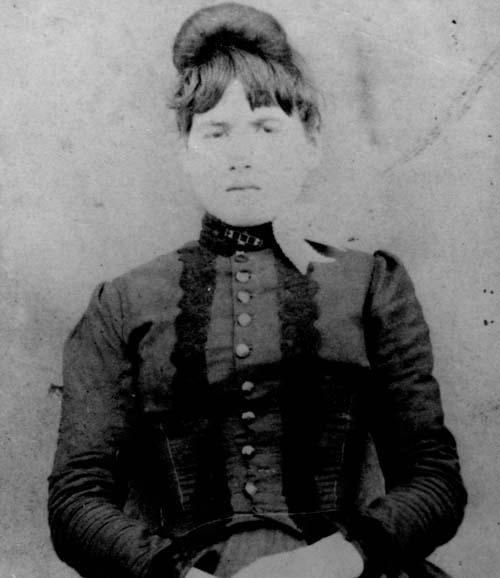
Elva Zona Heaster Shue, murder victimClick on the image to enlarge/zoom
Zona was buried quickly, and for many, that might have been the end of the matter. But her mother, Mary Jane Heaster, could not shake a deep and growing suspicion. She had never trusted Edward Shue, and in the days following the funeral, her unease hardened into certainty. According to her later testimony, she began to experience a series of visions in which her daughter appeared to her at night. In these encounters, Zona’s spirit told her that she had not died of natural causes, but had been murdered by her husband. She described in detail how he had flown into a rage and broken her neck, twisting her head completely around. The visions were said to occur over several nights, each time revealing more detail, until Mary Jane became convinced that what she had been shown was the truth.
Driven by grief and determination, Mary Jane went to the local prosecutor and insisted that her daughter’s body be exhumed. At first, her claims were met with skepticism. Stories of ghosts and visions were not evidence, and yet her conviction was so strong, so unwavering, that it raised doubts where there had been none. Eventually, authorities agreed to reopen the case. Zona’s body was brought back for examination, and this time, without interference, the truth began to emerge. The autopsy revealed that her neck had indeed been broken, the vertebrae crushed and the windpipe damaged in a manner consistent with strangulation. What had been dismissed as a natural death was now unmistakably a homicide.
Edward Shue was arrested and brought to trial. During the proceedings, the case drew widespread attention, not only because of the shocking nature of the crime but also because of the role Mary Jane’s visions had played in bringing it to light. The defense attempted to discredit her by emphasizing her belief that her daughter’s ghost had guided her, suggesting that grief had driven her to delusion. Yet in a strange twist, her testimony was allowed to stand, and while the court did not formally recognize supernatural evidence, the story of the ghost lingered in the minds of jurors and spectators alike. Other witnesses spoke of Shue’s behavior, his possessiveness, and inconsistencies in his account of Zona’s death.
In the end, the jury found Edward Shue guilty of murder, and he was sentenced to life in prison. He would die behind bars a few years later, his reputation forever tied to the strange circumstances of the case. As for Zona, she was laid to rest once more, this time with the truth acknowledged and justice, at least in the eyes of the law, served.
What remains is a story that has endured for more than a century, one that blurs the line between folklore and documented history. The Greenbrier Ghost is often remembered as the only case in American legal history in which the testimony of a ghost helped solve a murder. Whether one believes in the supernatural or not, the events surrounding Zona Heaster Shue’s death continue to echo through time, a haunting reminder that sometimes the truth refuses to stay buried, no matter how deeply it is hidden.