
Location history
A full narrative history section
In reality, the lighthouses that came before Bodie Island were located on Pea Island, south of Oregon Inlet, in a region that is now submerged as a result of the inlet's migration to the south. Construction of the initial structure began in 1847, but its inadequate foundation led to its closure in 1859. In 1861, fleeing Confederate troops destroyed the second structure, built in 1859. They feared the Union might use it as an observation post during the Civil War. 1872 was the year that saw the completion of the third and current lighthouse, which still retains its original first-order Fresnel lens. The construction of this lighthouse took place on a fifteen-acre location further north and more inland. The National Park Service took over the Bodie Island Lighthouse in 1953 after converting it into an automated system in 1932. Additionally, oil-fueled electrical generators transformed the light into an electric lamp. It was not until 1940 that the lighthouse was completely automated, but until then, it was staffed. 1953 was the year that the generators were disconnected, and the commercial electric grid became the source of electricity consumption.
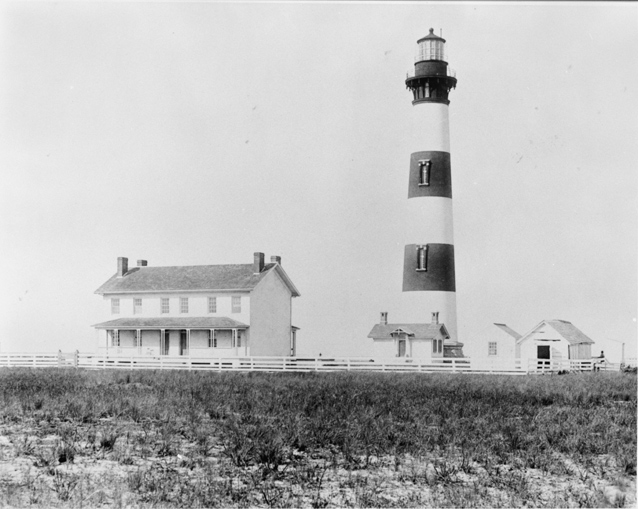
Bodie Island Light Station, 1893 - Library of CongressClick on the image to enlarge/zoom
Bodie Island Light Station, 1893 - Library of CongressClick on the image to enlarge/zoom
Source: LINK